
The Complete Guide for NEET, UPSC & NCERT Students
If you’ve ever wondered how a single cell manages to store the entire blueprint of a living being — from a tiny bacterium to a human being — the answer lies in one remarkable molecule: DNA. Understanding DNA structure isn’t just a biology chapter you memorize for exams; it’s the foundation for topics ranging from genetics and evolution to biotechnology and forensic science. Whether you’re preparing for NEET, UPSC, or simply revising your Class 10 or Class 12 NCERT syllabus, a rock-solid grasp of DNA structure will pay off across dozens of related topics.
Let’s break it down in a way that actually sticks.
What Exactly Is DNA?
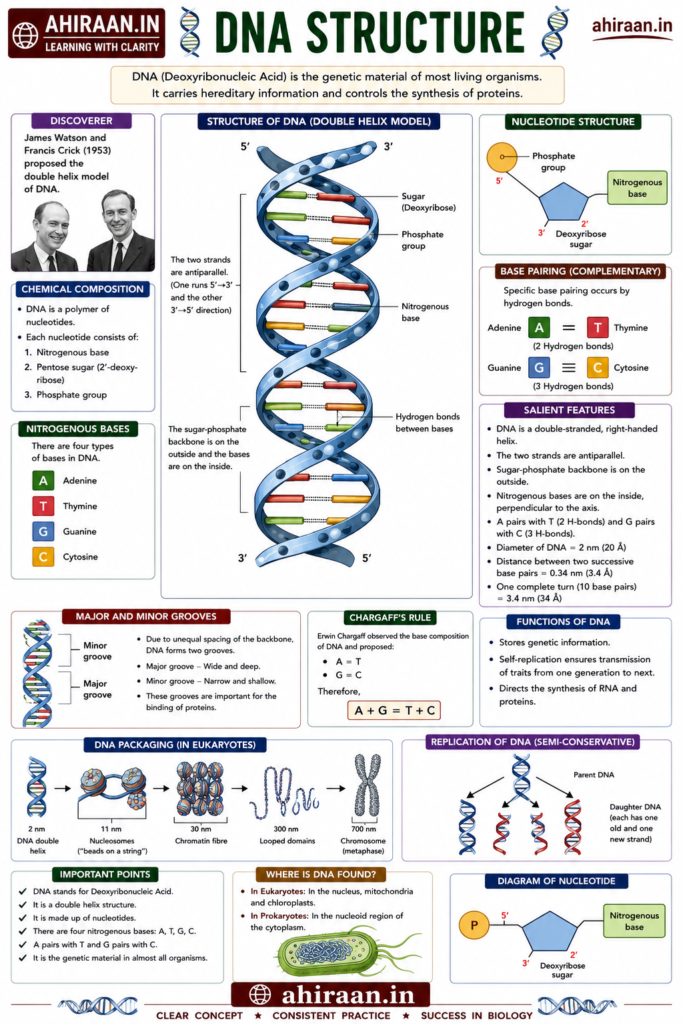
DNA, or Deoxyribonucleic Acid, is the genetic material found in almost all living organisms. It carries the hereditary instructions that determine everything from eye colour to how a protein folds inside your cells. In simple terms, DNA is the instruction manual of life — and like any good manual, it needs a structure that’s both stable and easy to “read” when required.
The Discovery That Changed Biology Forever
In 1953, James Watson and Francis Crick proposed the now-famous double helix model of DNA. This wasn’t a discovery made in isolation — it built on earlier X-ray diffraction work and years of biochemical research, but Watson and Crick were the ones who put the pieces together into a coherent 3D model. This single insight opened the door to modern molecular biology, genetic engineering, and much of the biotechnology we rely on today. It’s a favourite topic for exam questions, so remember the year (1953) and the names clearly.
Building Blocks: What Is a Nucleotide?
DNA is a polymer — a long chain made up of repeating units called nucleotides. Each nucleotide has three components:
- Nitrogenous base – the “information” part
- Pentose sugar – specifically 2′-deoxyribose in DNA
- Phosphate group – links nucleotides together
Think of each nucleotide as a single bead in a very long necklace, where the sugar and phosphate form the string, and the nitrogenous base hangs off to the side like a charm.
The Four Nitrogenous Bases
There are exactly four nitrogenous bases found in DNA, and every single trait you inherit is ultimately coded using just these four letters:
- A – Adenine
- T – Thymine
- G – Guanine
- C – Cytosine
These bases are divided into two chemical families: Adenine and Guanine are purines (double-ring structures), while Thymine and Cytosine are pyrimidines (single-ring structures). This distinction matters because it explains why base pairing always occurs between a purine and a pyrimidine — keeping the width of the DNA helix constant throughout its length.
Base Pairing: The Rule That Holds It All Together
DNA’s two strands don’t just sit side by side randomly — they’re held together through very specific, predictable pairing:
- Adenine pairs with Thymine (A–T), connected by 2 hydrogen bonds
- Guanine pairs with Cytosine (G–C), connected by 3 hydrogen bonds
This is called complementary base pairing, and it’s the reason DNA can replicate itself so accurately. Because G–C pairs have one extra hydrogen bond compared to A–T pairs, regions of DNA rich in G-C content are slightly more stable and require more energy (heat) to separate — a detail that occasionally shows up in advanced-level questions.
Chargaff’s Rule: A Pattern Worth Remembering
Long before Watson and Crick built their model, biochemist Erwin Chargaff studied the base composition of DNA and noticed something curious: in any DNA sample, the amount of Adenine always roughly equals the amount of Thymine, and Guanine always roughly equals Cytosine.
Mathematically: A = T and G = C, which means A + G = T + C
This observation was a major clue that eventually led to the double helix model, since it hinted that A must be structurally paired with T, and G with C.
The Double Helix: How It All Comes Together
Now for the structure itself. DNA exists as a double-stranded, right-handed helix — picture a twisted ladder. Here’s what makes this ladder unique:
- The sugar-phosphate backbone forms the two “rails” of the ladder, running along the outside.
- The nitrogenous bases form the “rungs,” positioned on the inside, perpendicular to the helix’s central axis.
- The two strands run in opposite directions — one strand runs 5′ to 3′, while the other runs 3′ to 5′. This is described as the strands being antiparallel, and it’s a detail examiners love to test.
Because of the way the backbone is arranged, the helix doesn’t have uniform spacing all the way around — this creates two grooves of different sizes:
- Major groove – wider and deeper
- Minor groove – narrower and shallower
These grooves aren’t just structural quirks; they’re functionally important because they provide sites where proteins (like transcription factors) can bind to DNA and read its sequence without unwinding the whole helix.
Key Numbers You Should Memorise
Exam setters love precise measurements, so keep these handy:
- Diameter of the DNA helix: 2 nm (20 Å)
- Distance between two successive base pairs: 0.34 nm (3.4 Å)
- Length of one complete helical turn: 3.4 nm (34 Å), containing 10 base pairs
How DNA Gets Packed Inside a Cell
Here’s something that often gets overlooked: if you stretched out all the DNA in a single human cell, it would measure around 2 metres — yet it fits inside a nucleus just a few micrometres wide. This is possible because of an elegant packaging system, especially in eukaryotic cells:
- DNA double helix (2 nm) wraps around histone proteins to form
- Nucleosomes, often described as “beads on a string” (11 nm), which coil into a
- Chromatin fibre (30 nm), which loops into
- Looped domains (300 nm), which condense further into a
- Chromosome visible during cell division (700 nm)
This hierarchical folding is what allows metres of genetic material to be safely stored, protected, and accessed only when needed.
Where Is DNA Found?
- In eukaryotes: primarily in the nucleus, but also in mitochondria and chloroplasts (organelles with their own small circular DNA — a key piece of evidence for the endosymbiotic theory)
- In prokaryotes: DNA is not membrane-bound; it’s located in a region of the cytoplasm called the nucleoid
How DNA Replicates: The Semi-Conservative Model
When a cell divides, it must copy its DNA precisely. This happens through semi-conservative replication, meaning each new DNA molecule contains one original (parent) strand and one newly synthesised strand. The complementary base pairing rules (A–T, G–C) ensure that each new strand is an exact match to its template, which is why replication is remarkably accurate despite happening on a massive scale, billions of times, in every organism.
Why DNA Matters: Its Core Functions
Boiling it down, DNA has three essential jobs:
- Storing genetic information — the complete set of instructions for building and running an organism
- Enabling self-replication, ensuring traits are passed from one generation to the next
- Directing protein synthesis, by first producing RNA (transcription), which is then used to build proteins (translation)
Quick Revision Checklist
- DNA stands for Deoxyribonucleic Acid
- It has a double helix structure, discovered by Watson and Crick in 1953
- It’s built from repeating units called nucleotides
- Four nitrogenous bases: Adenine, Thymine, Guanine, Cytosine
- A pairs with T (2 H-bonds); G pairs with C (3 H-bonds)
- Strands are antiparallel with a sugar-phosphate backbone on the outside
- It is the primary genetic material in almost all living organisms
Final Thoughts
DNA structure is one of those foundational topics that keeps resurfacing throughout your biology preparation — in genetics, molecular biology, biotechnology, and even in current affairs around gene editing and genomics. Getting the fundamentals crystal clear now will save you a lot of confusion later when you tackle more advanced concepts like transcription, translation, and mutation.
Keep this guide handy for quick revision, and pair it with regular practice questions to lock in the concepts for good.
Ahiraan.in — Learning with Clarity

One response to “DNA Structure Explained”
Good information