
Preparing for the UPSC Civil Services Examination can feel overwhelming for beginners. With a vast syllabus, intense competition, and multiple subjects, many aspirants struggle to decide where to start. But with the right strategy, smart planning, and consistency, cracking UPSC Prelims 2027 becomes achievable.
This beginner-friendly guide will help you understand the complete UPSC Prelims 2027 preparation strategy, including study plans, subject-wise preparation, booklists, revision methods, and mistakes to avoid.
What is UPSC Prelims?
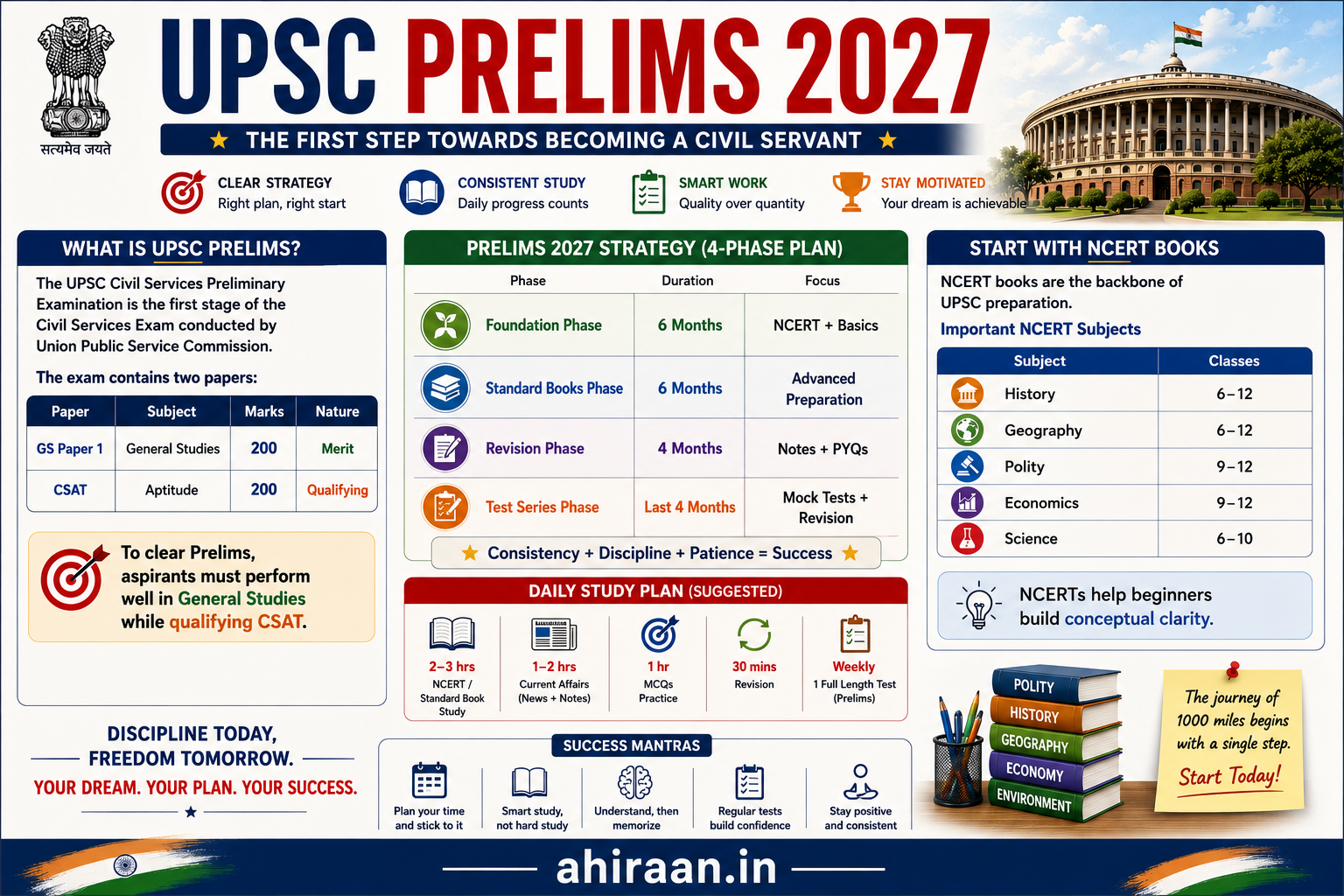
The UPSC Civil Services Preliminary Examination is the first stage of the Civil Services Exam conducted by Union Public Service Commission.
The exam contains two papers:
| Paper | Subject | Marks | Nature |
|---|---|---|---|
| GS Paper 1 | General Studies | 200 | Merit |
| CSAT | Aptitude | 200 | Qualifying |
To clear Prelims, aspirants must perform well in General Studies while qualifying CSAT.
UPSC Prelims 2027 Preparation Timeline
For beginners, a 1.5 to 2-year preparation timeline is ideal.
| Phase | Duration | Focus |
|---|---|---|
| Foundation Phase | 6 Months | NCERT + Basics |
| Standard Books Phase | 6 Months | Advanced Preparation |
| Revision Phase | 4 Months | Notes + PYQs |
| Test Series Phase | Last 4 Months | Mock Tests + Revision |
Step 1: Understand the UPSC Syllabus
Before starting preparation, carefully read the official UPSC syllabus.
Major subjects include:
- History
- Geography
- Indian Polity
- Economy
- Environment
- Science & Technology
- Current Affairs
Understanding the syllabus helps avoid unnecessary study material and keeps preparation focused.
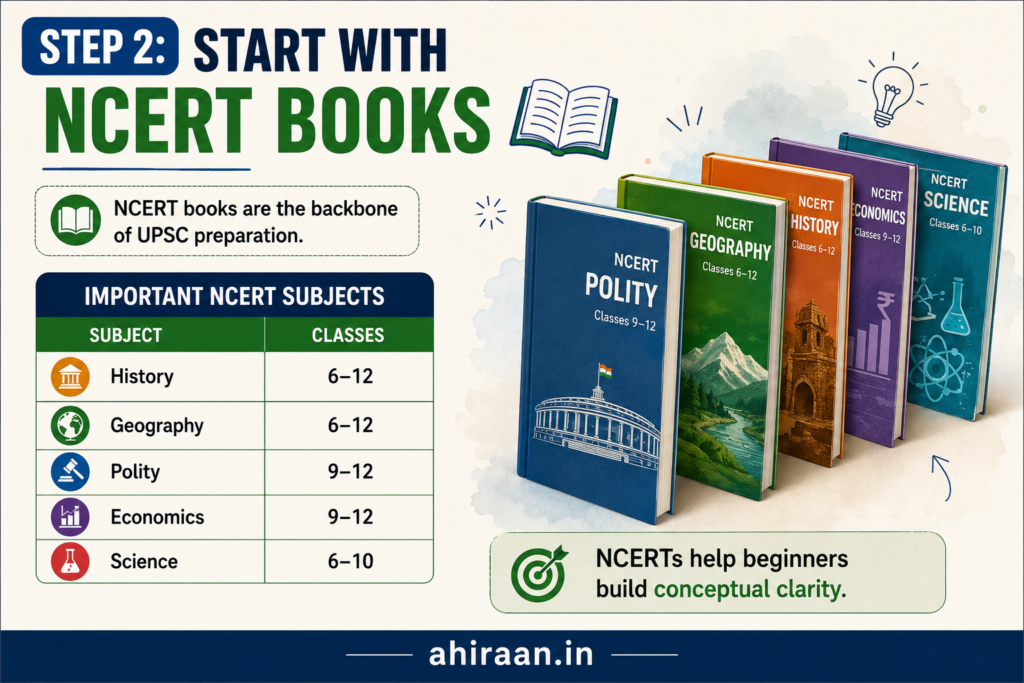
Step 2: Start with NCERT Books
NCERT books are the backbone of UPSC preparation.
Important NCERT Subjects
| Subject | Classes |
|---|---|
| History | 6–12 |
| Geography | 6–12 |
| Polity | 9–12 |
| Economics | 9–12 |
| Science | 6–10 |
NCERTs help beginners build conceptual clarity.
Step 3: Read Standard Reference Books
After completing NCERTs, move to standard UPSC books.
| Subject | Best Book |
|---|---|
| Polity | M. Laxmikanth |
| Modern History | Spectrum |
| Geography | G.C. Leong |
| Economy | Ramesh Singh |
| Environment | Shankar IAS |
| Ethics | Lexicon |
These books are highly recommended by toppers.
Step 4: Build a Daily Study Routine
Consistency matters more than studying 15 hours randomly.
Ideal Daily Schedule for Beginners
| Time | Activity |
|---|---|
| Morning | Newspaper + Current Affairs |
| Afternoon | Static Subject Study |
| Evening | MCQs Practice |
| Night | Revision |
Study 6–8 hours daily initially and gradually increase productivity.
Step 5: Current Affairs Strategy
Current affairs play a major role in UPSC Prelims.
Best Sources & Very Important Resources Section
Focus on These Topics
- Government schemes
- International relations
- Environment
- Economy
- Science & Tech
Step 6: Practice Previous Year Questions (PYQs)
PYQs are one of the most important resources for UPSC.
Benefits:
- Understand UPSC pattern
- Improve elimination techniques
- Identify important topics
- Learn question trends
Solve at least 10 years of Prelims PYQs.
Step 7: Attempt Mock Tests
Mock tests improve:
- Speed
- Accuracy
- Time management
- Confidence
Try to attempt:
- 40–50 full-length mock tests before Prelims.
Analyze mistakes after every test.
Step 8: Revision Strategy
Revision is the key to success in UPSC.
Golden Rule
Revise one subject multiple times instead of reading new books repeatedly.
Best Revision Method
- Short notes
- Mind maps
- Flashcards
- One-page summaries
Subject-Wise UPSC Prelims 2027 Strategy
History
Focus more on:
- Modern India
- Freedom Struggle
- Ancient & Medieval basics
Geography
Study:
- Indian Geography
- Maps
- Climate
- Environment linkage
Polity
Important topics:
- Fundamental Rights
- Parliament
- Judiciary
- Constitutional Bodies
Economy
Focus on:
- Budget
- Inflation
- Banking
- GDP
- Fiscal policy
Environment
One of the highest-scoring areas in recent years.
Study:
- National Parks
- Climate Change
- Biodiversity
- International Conventions
CSAT Strategy for Beginners
Many aspirants ignore CSAT and fail.
Practice:
- Reading comprehension
- Logical reasoning
- Basic mathematics
Practice regularly every week.
Common Mistakes Beginners Must Avoid
1. Reading Too Many Books
Stick to limited sources.
2. Ignoring Revision
Without revision, retention becomes weak.
3. Delaying Mock Tests
Start MCQs early.
4. Ignoring Current Affairs
Daily current affairs are essential.
5. Studying Without a Plan
Create weekly and monthly targets.
Best UPSC Prelims 2027 Preparation Tips
- Stay consistent
- Avoid social media distractions
- Make handwritten notes
- Focus on conceptual clarity
- Revise regularly
- Practice MCQs daily
Can Beginners Crack UPSC in First Attempt?
Yes, thousands of aspirants clear UPSC every year in their first attempt through disciplined preparation and smart strategy.
Success in UPSC depends on:
- Consistency
- Patience
- Proper planning
- Revision
- Test practice
Final Words
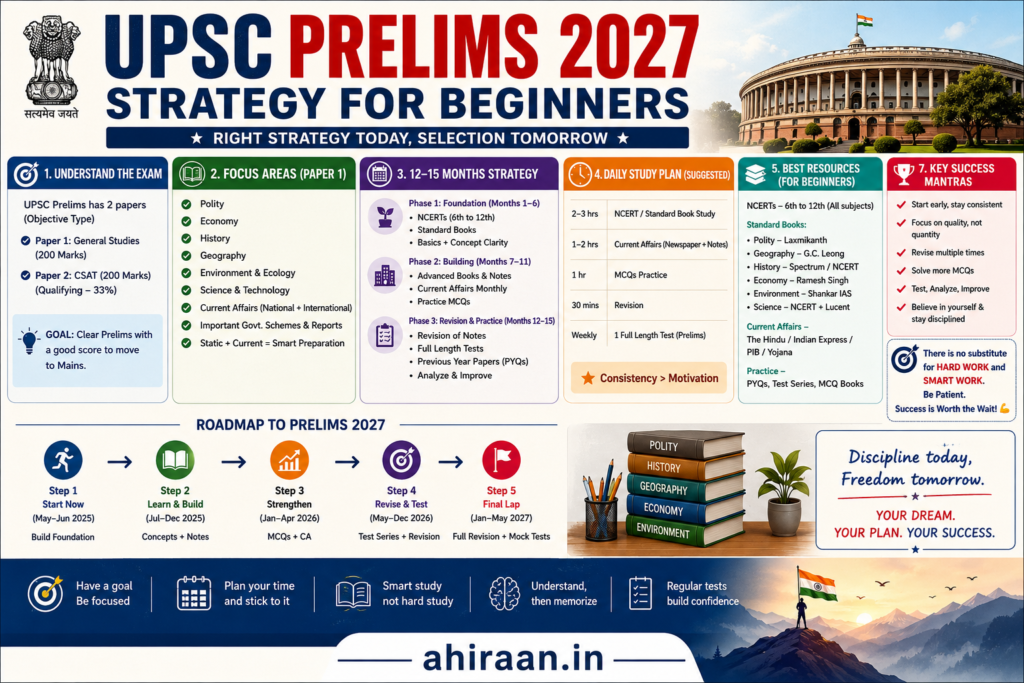
UPSC Prelims 2027 preparation is a long journey, but beginners can succeed with the right roadmap. Start with NCERTs, follow standard books, revise consistently, and practice mock tests regularly.
Remember:
- Small daily improvements create big results over time.
- Start your UPSC 2027 preparation today and stay consistent with your goals.
One response to “UPSC Prelims 2027 Strategy for Beginners – Complete Roadmap to Crack UPSC in First Attempt”
Good 😊